
“I’m a 59-year-old man who has been diagnosed with breast cancer twice. I’m passionate about raising awareness of male breast cancer and urge all men to get any changes to their body checked out with their GP. By acting as early as possible, it could save their life.
Before my first diagnosis, I was a very fit, active and healthy 44-year-old. It was 2011, I’d served in the military for 12 years, had completed a few marathons and was a member of a running club. I’d just started training for the legendary Marathon des Sables, a multi-day ultramarathon across the Sahara Desert, during which you carry a backpack containing all your food and equipment. I’d been training while wearing the backpack and felt some irritation from it on the left-hand side of my chest. I then noticed a lump in the same area, which I decided to get checked out.
My doctor initially diagnosed the lump as a cyst and he removed it in the surgery under local anaesthetic. There was no talk at all about the lump potentially being breast cancer.
At that time, I didn’t even know that men could get the disease and there was no history of breast cancer in my family either. My doctor stitched me up after removing what he thought was a cyst and sent off the tissue for testing.
Unfortunately, it wasn’t a cyst. Two weeks later, I was diagnosed with breast cancer.
The staff at Southend Hospital were amazing, but I went into a bit of a tailspin – asking myself how and why it could have happened. I was utterly shell-shocked. Being diagnosed with breast cancer hadn’t been on my radar at all.
I was told that I needed a mastectomy, followed by six monthly checks. It was a flip of a coin – could I get the surgery done in time and still train to do the Marathon des Sables? That’s what I actually managed to do! I had surgery to remove my cancerous lump in the November, went on my merry way and had recovered well by the time the Marathon des Sables came around in the April. I not only finished the event, but in a good position!
I found it very difficult talking openly about my first diagnosis.
It was made even harder by the fact that so much of the breast cancer treatment process was geared towards women. When I went for tests – including mammograms – I’d be the only man, which was quite a surreal experience. At almost every appointment, the receptionist would immediately turn to my partner and ask for her name and date of birth. She’d reply immediately ‘We’re here for Colin – not me’.
Life continued as normal for 14 years after my first diagnosis. I completed the Marathon des Sables for a second time, as well as a number of other events, including the Ultra Trail of Mont Blanc, a challenging 105-mile circuit of Mont Blanc, which has a greater elevation gain that the height of Mount Everest. This particular challenge became a real goal for me after I was diagnosed with cancer. It was something to distract me and I completed it in 40 hours! Then out of the blue, in 2026, I was then diagnosed with breast cancer again.
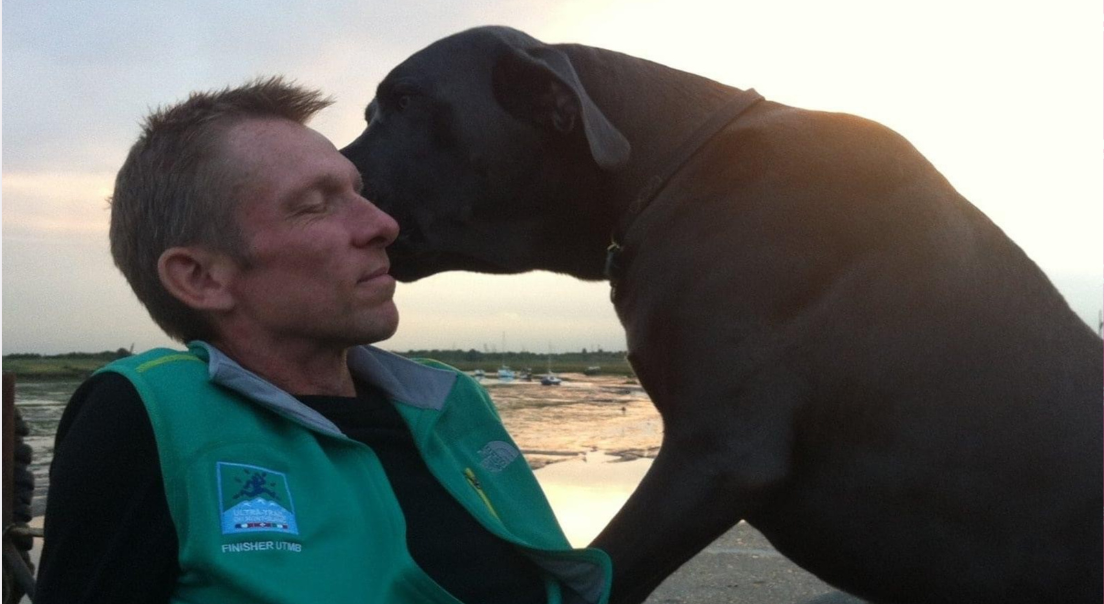 With my dog ‘Stig’. I’m wearing the Ultra Trail of Mont Blanc finishers gilet.
I still had a scar on my chest from the first surgery. At the end of the scar, where I’d had a drain following my operation, I noticed what looked like a boil on the surface of the skin. I assumed it was part of the scar tissue, but as it had got bigger, I made an appointment to see my GP to get it checked out. I had some steroid treatment, but that had no effect. We were in the process of moving, so I registered with a GP in our new town, as soon as I could.
The new doctor was absolutely phenomenal. He wanted to have the lump checked properly and a week later, I was having tests, including a biopsy, at a hospital in Windsor. I waited another couple of weeks for results and by now was resigned to the fact that I had breast cancer for a second time.
In my head, I expected everything would pan out as it had 14 years previously – a straightforward operation and that would be it. I was wrong.
This time I had a much more invasive form of breast cancer, which was much more concerning.
I had surgery to remove more breast tissue, this time going further into my armpits. During the operation, my surgeon also removed some of my lymph nodes. A speck of cancer was noticed on one of them, so they did some more tests, which thankfully all came back negative.
My results were sent to a specialist lab in the United States who recommended that I should have a five-day course of radiography and then take the hormone therapy Tamoxifen (a hormone therapy normally given to women with certain types of breast cancer) for five to ten years. The aim of both these treatments was to prevent my cancer coming back again.
Even though there had been a delay in getting my second diagnosis, because of our house move, my cancer was still caught relatively early. In the long run, that’s so important. My outcome could have been a lot worse, if I hadn’t acted when I did. I had some genetic testing, which came back negative too. That was very reassuring.
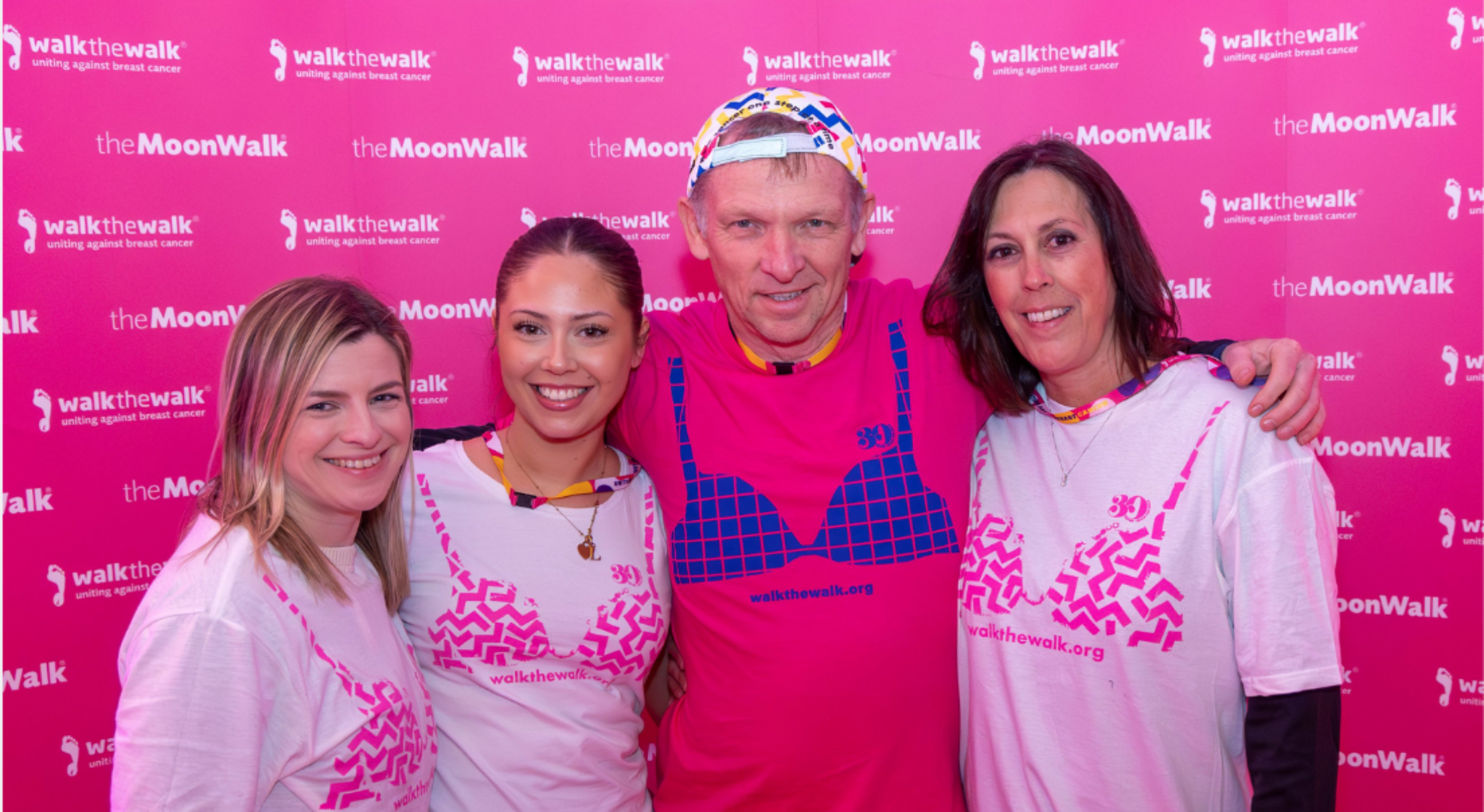
I’d done The MoonWalk London – organised by cancer charity Walk the Walk – once previously, but as soon as I shared the news about my second diagnosis with my family, they suggested that we all sign up for The MoonWalk together again as a group. There were ten of us taking on the Half Moon (15.1 miles) in May 2026, and we had a fantastic night – it was wonderful to be part of such a huge group, raising awareness about breast cancer in both women and men. .
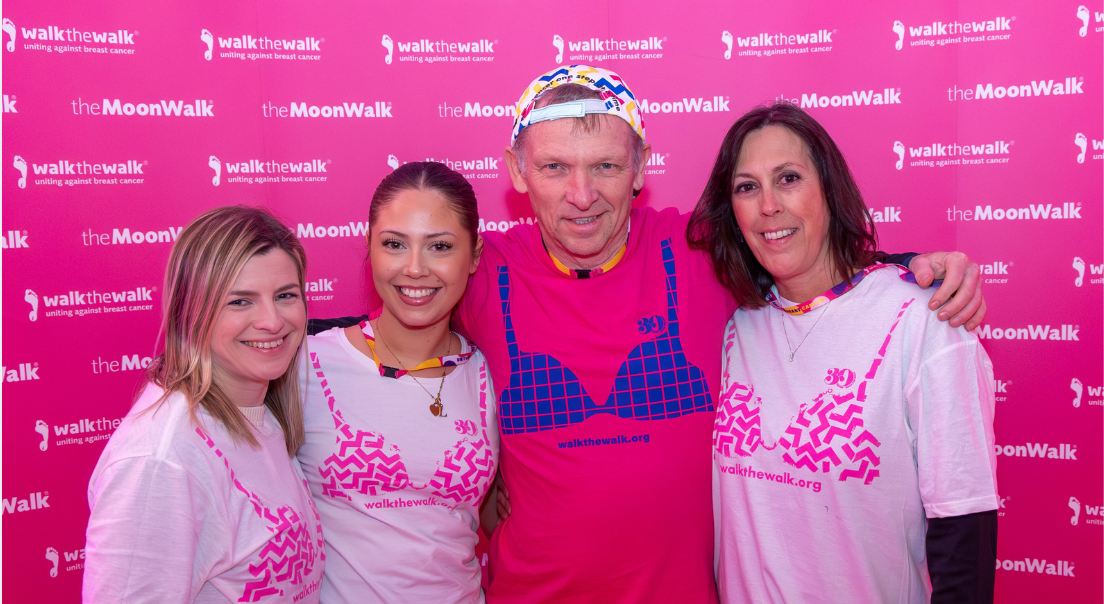
With my fiancée Sarah and daughters Lois and Chloe at The MoonWalk London 2026
Whilst I found it very hard at the time talking about my first breast cancer diagnosis, I have had a real change of mindset the second time around. For instance, I’ve been very open at work about what I’m going through. The company has around 300 staff members – roughly split fifty-fifty between men and women. We have an internal platform where you can publish articles about any subject you like, so I wrote about my diagnosis and treatment journey. It had an incredible reaction.
A large number of people contacted me and said they hadn’t known that men could get breast cancer.
They certainly do now! The way I see it, it’s all about spreading the word as much as we can. If I see someone talking on social media about raising awareness of breast cancer amongst women, I take the time to correct them and remind them to say that men get breast cancer too.
Early diagnosis of breast – and all cancers is crucial – for both men and women. Men shouldn’t be embarrassed to get any changes to their body checked out – whether it’s in their breast or elsewhere. The words “breast cancer” imply that it’s a female disease, so that could potentially challenge a man’s feeling of masculinity. But cancer is a disease and the bottom line is that cancer is cancer, no matter what part of the body it occurs in.
Men are notoriously bad at going to the doctor regarding anything abnormal. If it feels wrong, my message is – just get it checked out! It could save your life”.
Thank you for sharing your story Colin and for uniting with Walk the Walk to raise awareness that Men Get Breast Cancer Too.